The global community has a clear way forward if 20-30 countries can all do, just what PM Carney just did, and what Canada has been doing quietly, in terms of diversifying over the last 6 months, as he said it has. It’s the middle country collective that will help restore the balance which the world needs so urgently today.
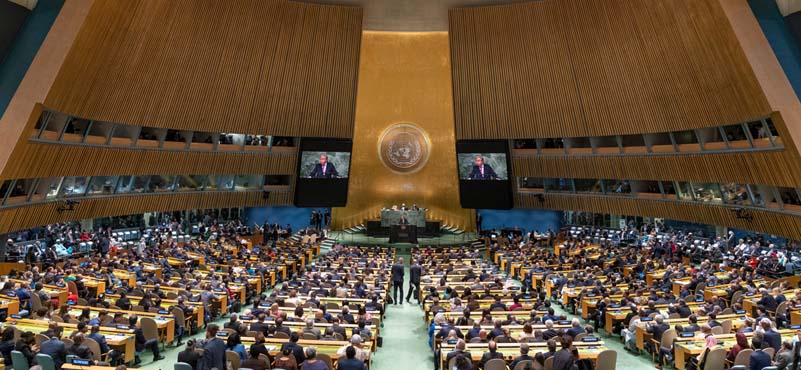
Despite its recent undermining and its known weaknesses (resulting largely from the illegal actions of its most powerful Member States in violation both of international law and the UN Charter and the scared, deafening silence of most other UN Member States including our own), the UN is still the closest to the type of premier global governance multilateral mechanism the world desperately needs. This is even more so at a time of accelerating, Artificial Intelligence (AI) driven globalization and multiple intersecting crises that range from illegal military interventions in Ukraine and Gaza by Russia and Israel, threatened land grabs by the United States (US) of Greenland, the autonomous arctic region of Denmark, abductions of Presidents, ignoring both sovereignty and diplomatic immunity under international law as in the case of Venezuela recently, US abetted Israeli genocide and systemic human rights abuses such as in Gaza and the Israeli Occupied Palestinian West Bank, the creation of a one man veto “Board of Peace” for Gaza and maybe other conflicts and an impending potential global tariff war.
There is no doubt that the UN needs to be reformed—even transformed—but it also simultaneously needs to be strengthened and properly resourced if it is to address the formidable peace and security, human rights, humanitarian, global public goods, sustainable development and other transnational challenges of the 21st century.
The 2024 UN Pact for the Future and its two related documents, the Global Digital Compact and the Declaration on Future Generations agreed at the UN Summit for the Future in New York by consensus in September 2024, are testimony to the fact that the UN will remain at center stage in terms of the world’s current and future global, regional and national governance architecture. The UN Charter’s principles and values are timeless and as relevant today as they were in 1945. While some important amendments to the Charter are unsurprisingly necessary to account for the considerable changes which have taken place from the time it was written and agreed more than 80 years ago, any attempt to start an entirely new process of creating a new Charter or building a new international Organization to replace the current United Nations would be a mistake and result in mayhem.
That said, geopolitical and geoeconomic events, especially since Trump 2.0 began on 20 January 2025, and his administration’s continuing undermining of global multilateralism of which the UN is both the anchor and bedrock, require yet another urgent reaffirmation of both the Charter and the Organization.
 Collectively, together with two of the UN Security Council’s (UNSC) Permanent 5 (P5) members, the United Kingdom and France, other middle powers such as Canada, Germany, Australia, New Zealand, Chile, Mexico, Japan, the Republic of Korea and key countries in the Global South (e.g. BRICS members such as Brazil, India and South Africa as well as Turkiye and ASEAN members such as Malaysia, Indonesia and Vietnam) should be prioritizing filling both the political legitimacy vacuum created by the US’ continuing and increasing defaults and the fast-growing liquidity and financial gap left by it as a result, in support of an appropriately adapted and reformed UN. They need to put their money where their mouth is when they plead allegiance to the UN Charter above all else as Canada’s Prime Minister Carney just did at the World Economic Forum in Davos, Switzerland only a few days ago and the European Union (EU) routinely does together with Mexico, Brazil and India, both in the corridors of the UN in New York and in their capital cities.
Canadian Prime Minister Carney’s speech at the World Economic Forum in Davos a few days ago is precisely the type of speech that all world leaders need to regularly and consistently make at this critical time of “rupture” of the post-World War II global order. Both President Trump and his Trump 2.0 now need to be taken on frontally through a united middle power North-South coalition.
The current illiberal conjuncture and financial gap in core funding to the UN leaves a vacuum which an illiberal China can and may well fill across the UN and the multilateral system if the countries mentioned above do not come together and prove that they are up to the challenge of protecting the liberal, democratic, global world order underpinned by the UN.
China’s contribution to the UNs core budget now amounts to around 20% of the UNs core budget. Its large voluntary contributions to UN activities and programs through its specialized agencies are also increasing while the US is cutting, most notably with its declared exit from around a total of 35 UN agencies, programmes and platforms since January 20, 2025, a year back.
Unlike the US, China has, so far, also been a more responsible UN member state in many ways since it remains committed to paying its core “assessed” contributions, even if its payments are often very late. The US was delinquent on them in 2025 and remains so. China has also, correctly, recently stated that it will not join Trump’s “Board of Peace” unless it is firmly embedded in the UN, not projected as an “alternative” to it.
Exercise of the P5 Veto Power in the UN Security Council
The most visible and talked about area that needs structural reform at the UN is the P5 Veto Power in its Security Council. While there is a strong case to abolish this because of its well documented and growing abuse and misuse, this is unrealistic and unlikely in the short term because the P5 will not give up the veto very easily or quickly.
Moreover, this veto power, agreed in 1945 as a prerequisite to UN Charter adoption, was built into the system as an insurance that the system itself would work and that the major powers would not act outside it. Despite the glaring and increasing exceptions mentioned above and the overwhelming use of it to protect one country, Israel, in particular, this overall insurance system had remained largely true in overall historical terms.
A strong case can certainly be made for restraint on the use of the veto (e.g. its use only for matters which are central for the absolute national security of a UN Member State). This may also be both more realistic and desirable.
There have already been a few noteworthy initiatives in the UN General Assembly (UNGA) to restrict the use of the veto and strengthen the accountability of the Security Council to the UNGA. This was already foreseen and envisaged when the UN Charter was drawn up in 1945, so it does not require any change to the UN Charter.
The most noteworthy of these is Liechtenstein’s 2020 “Veto Initiative,” spurred by deadlock at the UNSC on the Syrian war. While the resolution was delayed because of Covid-19, it was adopted in the UNGA by consensus on April 26, 2022. This was quite a remarkable achievement, led by one of the UNs smallest member states. It was also unprecedented since it “creates a standing mandate for the UNGA to be convened automatically, within ten working days, every time a veto has been cast in the Security Council.”
This Initiative needs to be urgently reinforced, mainstreamed and built upon. It is significant that three P5 members, the UK, France and the United States (during the Biden Administration) supported the Liechtenstein initiative while France together with Mexico, had initiated a declaration seeking restrictions on the use of the UNSC veto as far back as 2015.
Together with the “Uniting for Peace” mechanism, which allows the UNGA to step into and fill serious security gaps left by the Security Council, this should lead to greater accountability of the Council to the UNGA which is a more democratic body with universal membership, one-country, one-vote and no veto power. The 1950 Uniting for Peace resolution has also been increasingly invoked recently, both in the case of Ukraine and Gaza, including in a UNGA resolution and vote leading to Russia’s expulsion from the UN Human Rights Council.
ABOUT THE AUTHOR
 Kamal Malhotra is currently Distinguished Visiting Professor at the NALSAR University of Law, Hyderabad, India. He was a Non-Resident Senior Fellow at the Boston University Global Development Policy Center between June 2022-May 2025. He has also Guest Lectured at the School of Interwoven Arts and Sciences (SIAS), Krea University, India. Prior to his retirement from the United Nations in September 2021, Mr. Malhotra had a rich career of over four decades as a management consultant, in senior positions in international NGOs, as co-founder of a think-tank, FOCUS on the Global South, and in the United Nations (UN) including as its Head in Malaysia, Turkiye and Vietnam (2008-21). He was UNDPs Senior Adviser on Inclusive Globalization, based in New York, USA, for most of the prior decade. Mr. Malhotra is widely published.