
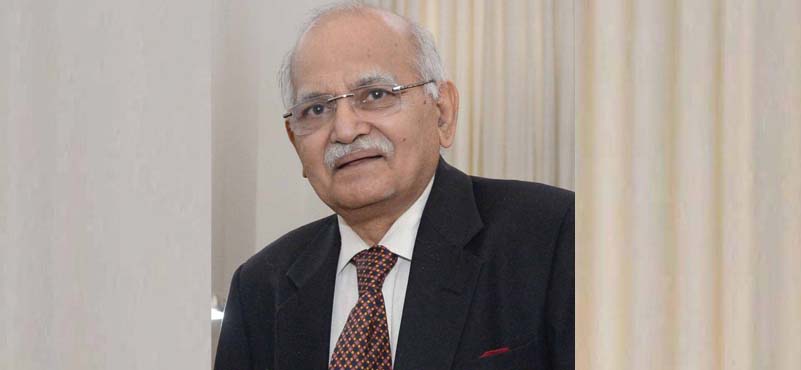
In Conversation with S K Misra, Chairman, Indian Trust for Rural Heritage and Development, has been a crusader for culture, tourism and heritage, over several decades. A former chairman of INTACH, formerly principal secretary to Prime Minister Chandrashekhar, SKM was a Haryana cadre IAS officer, sharing vintage with R C Bhargava (presently, chairman, Maruti) and Naresh Chandra, the late IAS officer who served as Governor J&K and Ambassador in Washington. In his most distinguished career, now in his 94th year, SKM has launched Haryana on the tourism map, then as the start up in highway tourism; later, as secretary tourism at the centre, he launched the Suraj Kund Mela; launched the Festivals of India in USA and later in France in the mid-80s.
He also set up the Motilal School of Sports in Rai, which he considers his most satisfying achievement, as it provides a high level of education as a public school to the less privileged sections in society. Starting with just seven students, the school now has a strength of 800.
Navin Berry: How come you thought of Buddha, Sir?
SKM: The organization that I head, India Trust of Rural Development and Heritage, it is primarily concerned with rural development, for conservation of rural heritage and we have taken up conservation of Terracotta Temples in Jharkhand and others, among various other projects. It occurred to me that there is a need to focus on Buddhist rural heritage, because there are a large number of Buddhist sites not only in places like Sarnath and Rajgir, but in the rural areas spread all over India, in Bihar and Andhra and Gujarat and UP; in the interiors, there are a number of shrines, monasteries, other things, which have remained neglected. They were being looked after at a particular stage of time, but then they have been abandoned.
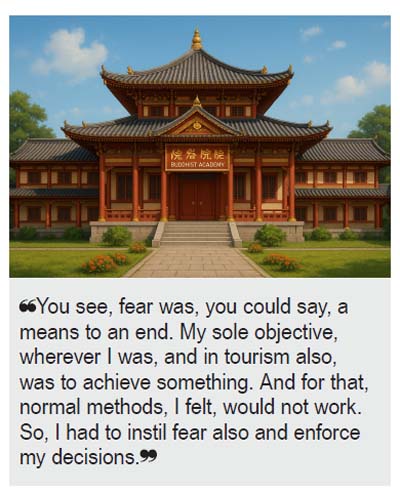 We felt that was part of our precious heritage and that there was need to set up an academy for management and conservation of Buddhist heritage because no such academy exists in India. And then we thought that this would attract scholars and students from Buddhist countries. We also felt that this would be an impetus to tourism because once these areas opened up, they would involve the local communities in looking after those monuments. In order to carry this forward, we decided that it was necessary to get expert opinion from all over and for that purpose we thought we’ll organize an international conference to get experts.
Navin Berry: So, is the aim of the conference then also to identify what could be the pillars around the academy?
SKM: Basically, that is the objective and to carry that forward we also wrote to the Chief Minister of Andhra because Andhra is one place that has a lot of Buddhist rural heritage. We asked them for 5 acres of land which they have given to us in Nagarjuna Sagar. The land is alloted, the first step has already been done.
It is a very good location, with a large number of Buddhist sites around. There are some Buddhist institutions, a large water body; it’s a part of 25 acres where all such institutions will come up.
Navin Berry: You will need some funds also for the academy, I suppose?
SKM: Well, we’ll have to raise funds.
Navin Berry: So, will the conference provide some little boost in that direction?
SKM: Well, the successful outcome of the conference will help us in raising funds, because the number of parties that have funded this forthcoming conference, they know of our ultimate objective and we will approach them, as part two of the overall exercise. Apart from that, we are hopeful of tapping international sources.
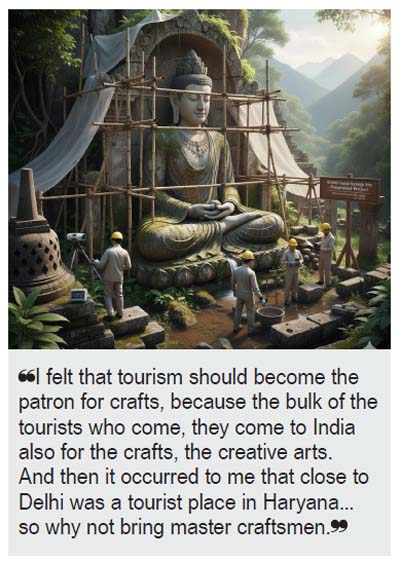 When we have everything in place, it’s easier to get funds. We have the land, we have the plans, we have all the details, like the curriculum, how we are going to run it, and that is projected to international bodies also.
I am very hopeful we will get the funds required.
Navin Berry: Going back in time, to kind of understand your personal journey, your career has been marked singularly for creation of new institutions. I have been a witness personally to many of them, since 1974-75 is when I first met up with you, when you were chairman of Haryana Tourism Corporation. And that kind of vision, that kind of enthusiasm, those days you were not as mild as you are now. You were almost like a feared person within the administration circles. And I remember going to the late Ashok Pahwa, then MD of Haryana Tourism Corporation, and his saying to me, ‘tumhe pata nahi hai tum kis aadmi se mil ki aaye ho’ ( you don’t know what calibre of person whom you have met just now). His word is law.
SKM: You see, fear was, you could say, a means to an end. My sole objective, wherever I was, and in tourism also, was to achieve something. And for that, normal methods, I felt, would not work. So, I had to instil fear also and enforce my decisions.
Navin Berry: No, but along with your fear, if I look back, sir, you were able to attract appreciation, you were able to attract talent, loyalty. So, all of it came along with that. And I think the biggest contribution you’ve been making all these years is to look at different things from time to time, visualizing them, like festivals of India, and then the Surajkund Crafts Mela. Then, of course, your present trust and now this Buddhist Academy. How do you look back on this?
SKM: You see as I moved along in my career, I mean nothing was sort of preordained. As I went along, ideas struck me. Now, for example, take the case of Surajkund Mela. I was Development Commissioner, Handlooms and I came in contact with weavers and I found they had a problem of marketing. Then, when I took over tourism, it struck me that earlier you had the Maharajas who provided patronage to crafts people. Over time, this patronage was not available and none other to replace it.
I felt that tourism should become the patron for crafts, because the bulk of the tourists who come, they come to India also for the crafts, the creative arts. And then it occurred to me that close to Delhi was a tourist place in Haryana. So why not bring master craftsmen from all over the country, pay for them, the transport, the board, lodging, everything, and they demonstrate to the people their skills.
Now it started on a small scale, about 25 of them; over the years it expanded, it became international, where 30-40 countries participate, with a million visitors over two weeks.
Navin Berry: When you look back over Surajkund Crafts Mela, as one of your contributions, what is the kind of feeling that you get?
SKM: Well, I have a mixed feeling. You see, the intention that I started has not been fully carried forward. My intention was that it should be just master craftsmen. But what has happened over the years and initially for a few years we had genuine craftsmen. But now a lot of traders have got in. So the original intention has been somewhat diluted. But it has a more popular appeal because it now caters to all sections of society.
Navin Berry: But when you say it’s got diluted, would you… it’s got been taken over by… let’s say people who already… they’re marketeers and not necessarily the craftsmen themselves.
SKM: No, basically they are craftsmen. I mean, bulk of them are craftsmen. But it is diluted that you have… traders getting in, those that are not crafts people in themselves. But I suppose that’s a small price to pay because it has become known worldwide and it provides a major source of attraction for people and generates a lot of employment. So, I’m not unhappy but I’m just saying that I wish it……
Navin Berry: But do you feel now, talking about crafts, talking about rural kind of heritage that we are talking about, is there more awareness now?
SKM: There is greater awareness. In fact, I had wanted this crafts mela to be extended on a regional basis. Each region should have a crafts fair. Then there will be much greater emphasis and thrust on this thing. One event in a year is not adequate.
Navin Berry: Sir, you mentioned the word tourism a couple of times and also mentioned Buddhist tourism in particular. And since we are now looking at Buddha in this forthcoming conference – Buddhist tourism, international tourism has not really taken the kind of momentum that we have in terms of the potential that we have. So, you have also been head of tourism for a long period at the center. Any comments on that as to what has been lacking? What do we need to do to promote Buddhist tourism?
SKM: When I was Secretary, we gave a lot of emphasis to Buddhist tourism. In fact, Ramesh Chandra (then joint secretary in the ministry) was put on this job, and he prepared a special report, and we had a plan of action. But unfortunately, that thrust was not there later on. Now, with this conference, with the academy coming up, with state governments getting involved, and when the academy comes up, with greater involvement of the state governments, I think it’s bound to bring about a major change. And I’m very hopeful that it will give tourism a big boost.
And there are representatives from 15 countries at this conference. They will carry the message. And they will give this example. And we are going to involve them also in the academy and in other issues relating to promotion of tourism from their countries, from others. I’m very hopeful that this will act as a major catalyst for development of tourism.
Navin Berry: A major component of the Buddhist heritage that we have is in Bihar?
SKM: Also UP, Andhra has a lot, Gujarat has a lot. These are not that well known. But all these have significant Buddhist heritage in the rural areas.
Navin Berry: Any major participation you envisage from Bihar government?
SKM: At the moment we will be focusing on Andhra. Once we start this thing, what we plan to do is, side by side when the academy is set up, we will also set up special task force for identification of sites. And then Bihar comes in, Gujarat comes in. In different states, we’ll have different teams identifying. I’ve already worked out some details of how these streams should be constituted, what they should look into, how they identify, it should be detailed identification on the basis of which then further conservation work can be done.
Navin Berry: I am very sure, and all of us are very confident of a very successful conference. I am curious to know what is going to be your next project after this. What next?
SKM: My next project is academy.
Navin Berry: What kind of timeline are you giving to the academy, how big is the Academy going to be?
SKM: Well, it will have to be phased out, but I think the first phase should take two years to come up. We will ensure we start with a professionally trained academy, build up a cadre of conservationists. And it’s not just architectural heritage that we will focus upon, it is also intangible heritage.
Navin Berry: Any special message for the delegates at the conference?
SKM: Well, we look forward to their participation and we are hopeful that the outcome will be positive and their involvement is not just limited to the conference. As I mentioned, we will involve them later on with the academy, some of them we will identify, they may be visiting professors, some may be tourism experts, so we have this core group now and this core group will help us to carry forward our future plans.
The PRBH Conference Kicks OffPrelude to the first ever Buddhist Academy in the country
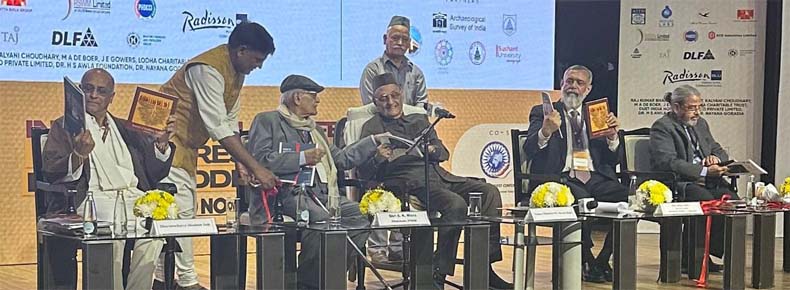
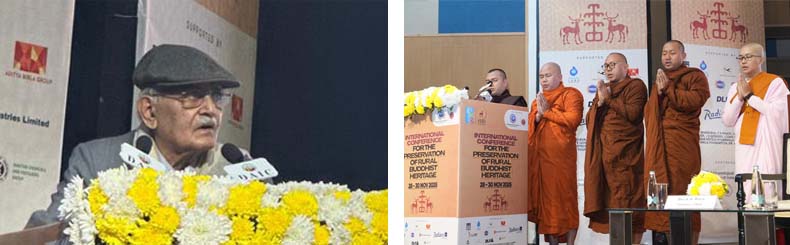
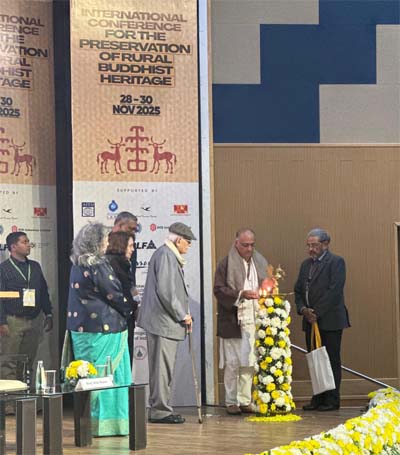 The PRBH conference took off to a great start, with the Buddhist chanting for peace and goodwill. With keynotes from Dr. Karan Singh, chairman ITRHD S K Misra, vice chairman A G K Menon, and Abhijit Halder, director general, International Buddhist Confederation. All in singular acclaim for the vast Buddhist heritage across the country, the need to preserve it, as a community way of living, as a force for tourism, as the much-needed effort to preserve the heritage of India, across faiths.
With some 300 delegates attending the three-day conference, technical sessions preceded to put together thought processes as inputs for the proposed Buddhist Academy, expected to roll out its first phase in the next two years. Andhra Pradesh government has generously allocated a five-acre land for the same. As the first of its kind in the country, it can become a precursor to more such capacity building in the country, where the opportunity is vast, resources both in skills and money are limited. Such efforts will boost employment potential in rural areas, empowering local communities to become the true guardians of their heritage, the immediate environment.